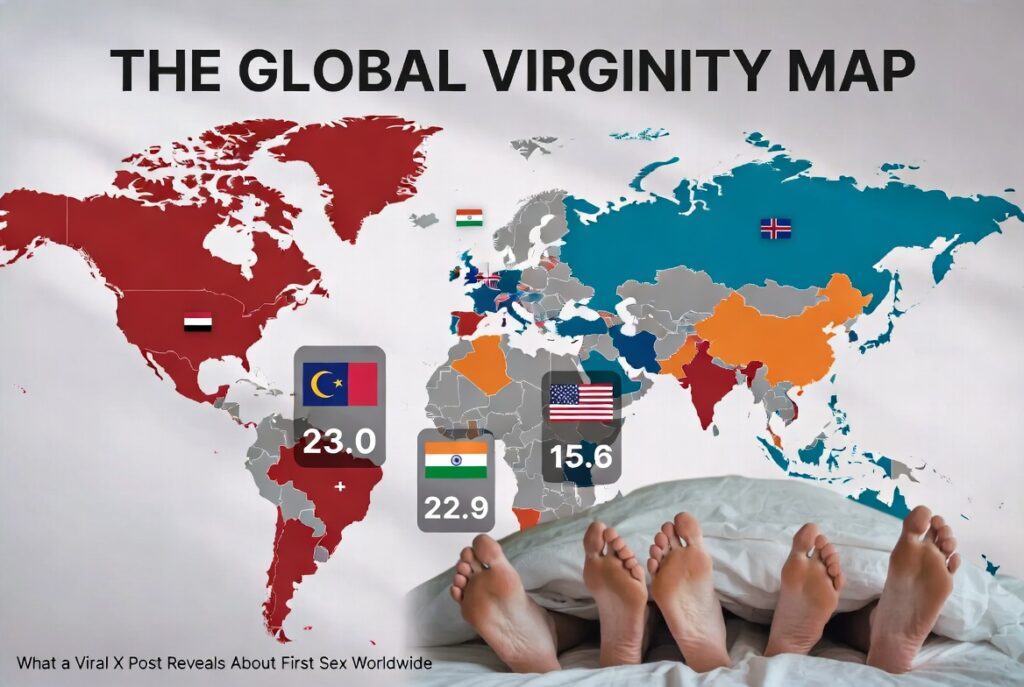
it lists the average age at which people in 44 countries lose their virginity — complete with country flags and a cheeky stock photo of four feet poking out from under rumpled white bedsheets. The thread quickly exploded into a full ranking, sparking debates about culture, liberalism, tradition, birth rates, and everything in between.The data isn’t new.
It comes from Durex’s “The Face of Global Sex” survey (conducted around 2012 and widely reported by the Daily Star in 2016). It’s self-reported, covers both men and women, and reflects attitudes from over a decade ago. Still, its resurgence shows how fascinated we remain with one of life’s most private milestones — and what it supposedly says about societies.The Full Ranking (Oldest to Youngest)Here’s the complete list as shared in the viral thread:
| Rank | Country | Average Age |
|---|---|---|
| 1 | Malaysia | 23.0 |
| 2 | India | 22.9 |
| 3 | Singapore | 22.8 |
| 4 | China | 22.1 |
| 5 | Thailand | 20.5 |
| 6 | Hong Kong | 20.2 |
| 7 | Vietnam | 19.7 |
| 8 | Nigeria | 19.7 |
| 9 | Japan | 19.4 |
| 10 | Spain | 19.2 |
| 11 | Indonesia | 19.1 |
| 12 | Poland | 19.0 |
| 13 | Italy | 18.9 |
| 14 | Taiwan | 18.9 |
| 15 | Russia | 18.7 |
| 16 | Mexico | 18.7 |
| 17 | South Africa | 18.7 |
| 18 | France | 18.5 |
| 19 | United Kingdom | 18.3 |
| 20 | Switzerland | 18.2 |
| 21 | Canada | 18.1 |
| 22 | Netherlands | 18.1 |
| 23 | Greece | 18.1 |
| 24 | United States | 18.0 |
| 25 | Australia | 17.9 |
| 26 | Turkey | 17.8 |
| 27 | New Zealand | 17.8 |
| 28 | Slovakia | 17.8 |
| 29 | Germany | 17.6 |
| 30 | Brazil | 17.4 |
| 31 | Ireland | 17.3 |
| 32 | Croatia | 17.3 |
| 33 | Austria | 17.3 |
| 34 | Czech Republic | 17.2 |
| 35 | Chile | 17.2 |
| 36 | Belgium | 17.2 |
| 37 | Portugal | 16.9 |
| 38 | Bulgaria | 16.9 |
| 39 | Israel | 16.7 |
| 40 | Finland | 16.5 |
| 41 | Norway | 16.5 |
| 42 | Sweden | 16.2 |
| 43 | Denmark | 16.1 |
| 44 | Iceland | 15.6 |
Global average in the survey: around 17.3 years.Clear Regional PatternsThe numbers aren’t random. They cluster along cultural, religious, and economic lines:
- Later starters (19–23 years): Predominantly East and Southeast Asia (Malaysia, India, Singapore, China, Japan, etc.) plus Nigeria. Strong emphasis on family honor, academic pressure, religious conservatism, and arranged or delayed relationships plays a major role. In many of these societies, marriage and financial stability often precede sex.
- Middle of the pack (18–19 years): Southern and Central Europe (Spain, Italy, Poland), parts of Latin America, and Anglo countries like the UK, US, Canada, and Australia. A mix of moderate religious influence, urban modernity, and balanced sex education.
- Earliest starters (15.6–17 years): Northern Europe — especially Scandinavia (Iceland youngest at 15.6, followed by Denmark, Sweden, Norway, Finland). These countries are known for progressive sex education starting in primary school, high gender equality, liberal attitudes toward premarital sex, and strong social safety nets that reduce the “risk” factor around early relationships.
Countries with large Muslim or Confucian-influenced populations tend to appear later on the list; highly secular, welfare-state societies appear earlier. What Drives the Differences?Several factors consistently show up in research on age of sexual debut:
- Religion and Cultural Norms — Conservative interpretations of Islam, Hinduism, Christianity, or Confucianism often promote abstinence until marriage. Liberal secular societies treat sex as a normal part of adolescent development.
- Sex Education — Comprehensive, early, and non-judgmental programs (common in Scandinavia) correlate with slightly earlier but safer first experiences. Abstinence-only approaches or taboo-heavy cultures delay it — sometimes dramatically.
- Economics and Urbanization — Wealthier, more urban countries with later marriage ages and longer education periods often see delayed sexual debut. Conversely, in some developing contexts, earlier marriage can mean earlier sex.
- Gender Equality — Higher female autonomy and access to contraception tend to lower the average age without increasing negative outcomes.
- Media and Technology — The survey predates widespread dating apps and social media. Today’s teens in many countries encounter sexual content far earlier than in 2012, which could be shifting numbers (though we lack a comparable global update).
Important Caveats
- Old data. The world has changed. Smartphones, OnlyFans, #MeToo, rising mental health awareness, and post-pandemic loneliness have all altered how young people approach intimacy.
- Self-reported. People lie (or round up/down) about sex. Cultural stigma in conservative countries may inflate ages; bragging in liberal ones may lower them.
- Not the full picture. This measures average age of first intercourse, not quality, consent, safety, or satisfaction. It also doesn’t capture LGBTQ+ experiences well or account for forced encounters.
- Newer sources differ. Demographic and Health Surveys (DHS) used by World Population Review focus more on women in developing countries and sometimes show higher median ages in places like India or parts of Africa.
Why This Topic Still Goes ViralThe post taps into deeper anxieties: falling birth rates in early-sex countries, “declining masculinity” or “hyper-sexualization” debates, and nostalgia for “traditional values.” Replies ranged from “No wonder the West is dying” to celebrations of liberal freedom to outright skepticism (“How do they even know this?”).The truth is more nuanced.
Earlier sexual debut doesn’t automatically equal worse life outcomes — especially when paired with education and contraception. Later debut doesn’t guarantee happier relationships. What matters most is consent, safety, emotional readiness, and access to accurate information.Sex remains one of the most culturally loaded human behaviors.
A simple list of numbers becomes a Rorschach test: some see proof that “tradition works,” others see evidence that “repression delays adulthood.” The data itself is just data — a snapshot of how different societies have drawn the line between childhood and sexual maturity.The bedsheet photo in the original post is telling. Four anonymous feet, tangled sheets, no faces.
That’s the universal part. The numbers change by passport; the experience is deeply, messily human everywhere.What do you think — does culture shape when we start having sex more than biology or individual choice? Or has the internet already made these old national averages obsolete? Drop your thoughts below.